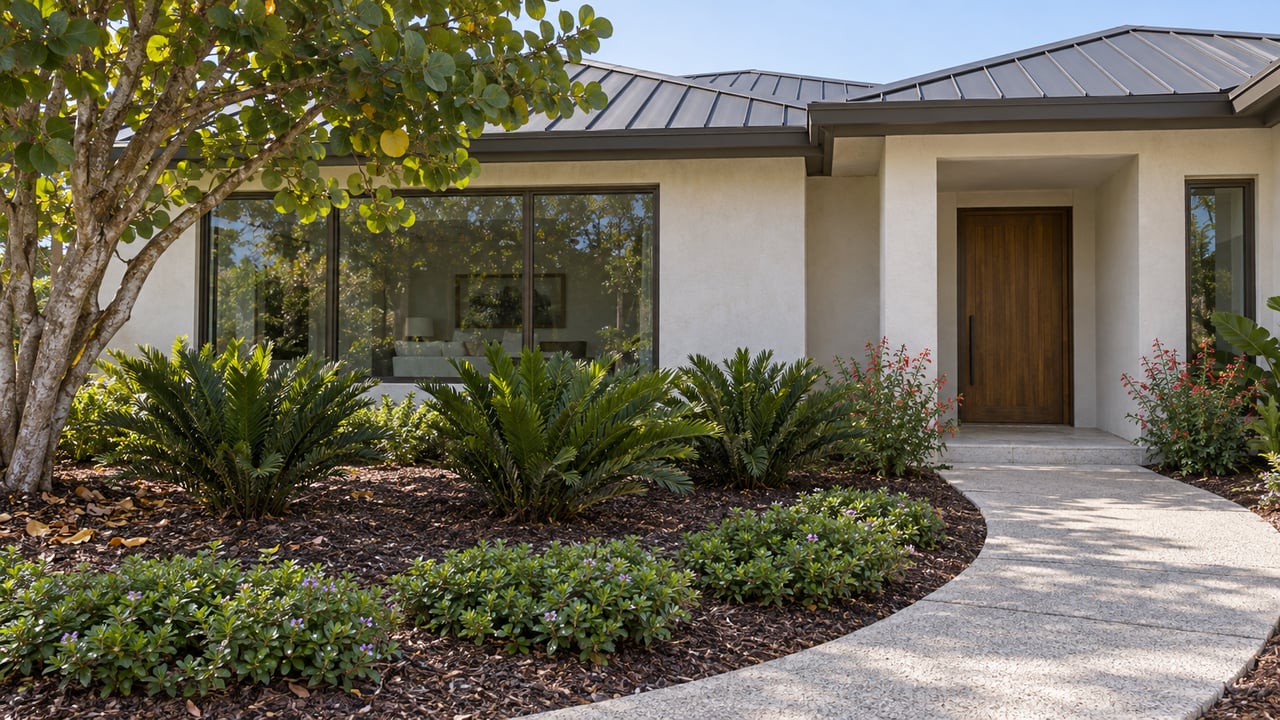
Seven Barrier-Island Gardens Open Their Gates November 8, and Indialantic's Orlando Park Hosts the Fair
October 29, 2026
October 29, 2026
One riverfront yard on this year's tour mixes native plants with tropicals, garden paths and hardscape, and its own profile puts the native share at a bit over half. A few stops away, another barrier-island lot has nothing but natives. Gumbo limbo, necklace pod, blolly, bay cedar, saw palmetto, sea grape, inkberry and cocoa plum grow there, along with several native grasses. Five more gardens fall between those two, and all seven open on Sunday, November 8, from 9 a.m. to 4 p.m.
This is the 17th year of the Florida Natives Tour from the Conradina Chapter of the Florida Native Plant Society. This year every stop is in Indialantic, in Melbourne Beach, or at the Barrier Island Sanctuary. The order is the useful part. Because the yards range from roughly half native to fully native, they show what an island yard looks like at each step of the change, under the same salt, sand and shade a homeowner here already deals with.
The tour's garden page lists each private garden by its owners' first names. In this table they're sorted by the native share each one reports.
| Garden | Native share | Setting | What it shows |
|---|---|---|---|
| Julia & Joe | Over 50% | Riverfront | Natives and Florida-friendly plants mixed with tropicals, paths and hardscape |
| Patricia & Larry | 80% | Mostly shaded | Lawn taken out gradually under salty barrier-island conditions |
| Craig & Tina | 80% | Mixed sun and shade | Nearly 30 Sabal palms, plus live oaks, southern red cedars, coontie and palmetto |
| Judi | Over 80% | Mixed sun and shade | A wild native garden with water features and four rain barrels |
| Karen & Gary | 90% | Mostly shaded | More than 20 preserved sand live oaks, with mahogany, paradise tree, red cedar and gumbo limbos added |
| Bill & Carol | 99.9% | Subtropical coastal hammock | More than 200 native species, designed as a wildlife refuge |
| Nichole & Erik | 100% | Barrier island | Gumbo limbo, necklace pod, blolly, bay cedar, sea grape, cocoa plum and native grasses |
Read from top to bottom, the table shows a property changing over time. Julia & Joe's yard keeps the tropicals and hardscape a lot of riverfront owners already have and adds natives around them. Patricia & Larry's profile centers on taking out lawn a little at a time in salty conditions, the slow route through the middle range. At the far end, Bill & Carol have built a hammock with more than 200 species, about as far as a residential lot can go.
Two of the middle gardens got to a high native share from very different starting points. Karen & Gary kept more than 20 sand live oaks and planted underneath and around them, adding gumbo limbos, mahogany and red cedar and growing saw palmetto habitat. Their yard is 90% native and mostly in shade.
Craig & Tina had almost nothing to keep. When they started, their profile says, the lot had hardly any plants or trees, just some Natal plums and a few Sabal palms. They dug up the Natal plums, and a freeze killed the Sabals. Since 1989 they have returned much of their third of an acre to native species. Today it has nearly 30 Sabal palms, live oaks, a magnolia and southern red cedars, with coontie and palmetto at ground level.
Both yards report 80% native or more. One reached it by keeping an existing canopy and planting below it. The other planted its canopy over roughly 37 years.
Organizer Saumya VanderWyst has converted her own yard, and she spoke about the people opening their gates in Hometown News: "Our homeowners are just an absolute hoot. They're so much fun, so passionate about what they do in the nicest of ways." She told the paper they "just want to wander and maybe fall in love with the plants like they are."
The private gardens show what one owner can do on one lot. The two public stops show the same plants working over a larger area.
The Surfrider Foundation stop is a bioswale planted entirely with natives. The Space Coast Surfrider Chapter built it with the Florida Wildflower Foundation and the Viva Florida program, and the tour sends visitors to park along 12th through 8th streets.
The Barrier Island Sanctuary covers 34 acres of coastal habitat managed by Brevard County's Environmentally Endangered Lands Program. Its tour profile describes restoration work from 2018 to 2020 that planted dune sunflower, beach elder, coontie, sea-oxeye daisy, blanket flower and seaside goldenrod. Several of those plants also turn up in the private yards, so a visitor who starts in a 100% native garden can see the same species again at sanctuary scale. Hometown News refers to the site as the Barrier Island Center at the Doc Earhart Sanctuary.
Orlando Park, at 1000 South Ramona Avenue, is the tour's home base in Indialantic. The town lists it as a 2.62-acre park with a hiking path, a picnic pavilion, a gazebo, basketball courts, a playground, benches and picnic tables. On November 8, it's also where ticket holders pick up their plants and where the chapter holds its first Conservation Fair.
Here's how a ticket works, based on the chapter's Square checkout and Hometown News:
Older event listings elsewhere may show different prices or dates. The chapter's own checkout lists $15 for Sunday, November 8. Get tickets through brevardlandscapetour.org, and look there for day-of updates.
You don't need a ticket for the fair. It's free and open to the public, and it gathers conservation nonprofits, local businesses and artists in one place. According to Hometown News, the participants include Brevard Zoo, the Marine Resources Council, St. Johns Riverkeeper, Florida Wildlife Hospital, Audubon and Surfrider. Children get a scavenger hunt built around hand-carved stamps of keystone plants.
Art is part of the tour too. Artists who work from native plants and wildlife will demonstrate at the private homes. The featured artwork includes Dodi Truenow's "Grass River Pines," Darleen Hunt's "Epiphytes," June Long-Sherman's and Dorothy Koliba's "Sea Grapes," and Gary Gresko's "Along the Waterway." The watercolor on the tour's homepage is C. Rose Allan's "Sea Grape Serenity."
The sponsor list is mostly local. Native Butterfly Flowers is the Oak Tree sponsor and Florida Custom Aquatic Services is the Pine Tree sponsor. Fox & Fern Native Landscapes, Go Native Landscaping, Publix and Semans Tree Service are at the Walter's Viburnum level. The Indian Harbour Beach Garden Club, the Island Garden Club and the Titusville Garden Club are among the Goldenrod sponsors, along with Florida Native Wildflowers, Susan Hall Landscape Architecture and others. Visitors who see a yard they like can find several of the businesses that do this kind of work on that list.
The table works as a route. Start at Orlando Park in the morning to pick up the plant and a printed brochure if you want one. Then visit the gardens closest to your own yard's native share before going on to the more advanced ones. If your lot is shaded and has oaks, Karen & Gary's and Patricia & Larry's gardens are the closest matches. On a riverfront lot with tropicals already planted, Julia & Joe's yard comes first. For a lot with little planted on it, Craig & Tina's garden shows what decades of replanting can do. The Surfrider bioswale and the Barrier Island Sanctuary show the same plants over a larger area, and the fair at Orlando Park runs until 4 p.m.
The town's next big date on Orlando Park's side of the island is the Christmas Tree Lighting on Thursday, December 3, from 6 to 8 p.m.
If your yard is partway through a change like the ones on this tour, with oaks kept and lawn going away, and you'd like to know how that work shows up in your home's value, Jamie Dandridge is glad to walk the property with you. Request a Home Valuation, and we'll look at the house and the ground around it together.
Stay up to date on the latest real estate trends.
Trust him for distinguished real estate service along Melbourne Beach’s coast. With his luxury-market expertise, local insight, and dedicated support, he ensures your buying or selling journey is seamless and successful.