The Indian Harbour Beach Median Price Everyone Quotes Is Off by $114,000
August 20, 2026
August 20, 2026
Pull up any portal search for Indian Harbour Beach this month and you'll see two numbers sitting next to each other that should roughly agree and don't. As of August 2026, the median home price is $499,900. The average sale price is $614,230. That's a $114,000 gap on a city that spans barely two square miles of barrier island.
A gap that size isn't a rounding error. It's a fingerprint. Somewhere in that math, a small number of very expensive sales are dragging the average well above where most transactions actually close, and if you're shopping here using the median as your budget anchor, you're planning around a number that describes almost nobody's actual purchase.
A median tells you the midpoint. Half the homes that sold cost more, half cost less. An average adds up every sale and divides by the count, which means it's sensitive to outliers in a way the median never is. When the average sits well above the median, that's the signature of a market with a long, thin tail of high-value sales pulling the number up while the bulk of transactions cluster underneath it.
Indian Harbour Beach currently has 25 houses for sale, priced anywhere from $189,000 to $7,000,000. That range alone tells you the average is doing a lot of work to represent a market that includes both ends. A handful of riverfront estates and gated-community sales at the top can move the average by six figures without changing what a typical buyer actually pays for a typical home.
The reason the spread is so wide is that Indian Harbour Beach isn't really one housing market. It's three, stacked on top of each other on a strip of land that's only a few blocks wide from the Atlantic to the Banana River.
The first is the dry-lot interior market: single-family homes on streets that don't touch water, in neighborhoods like Martesia, where prices start in the mid-$200s and top out around $600,000. This is the segment doing the heavy lifting on the median. It's also the segment a buyer relying on a headline price is probably picturing, even though it's not what's inflating the average.
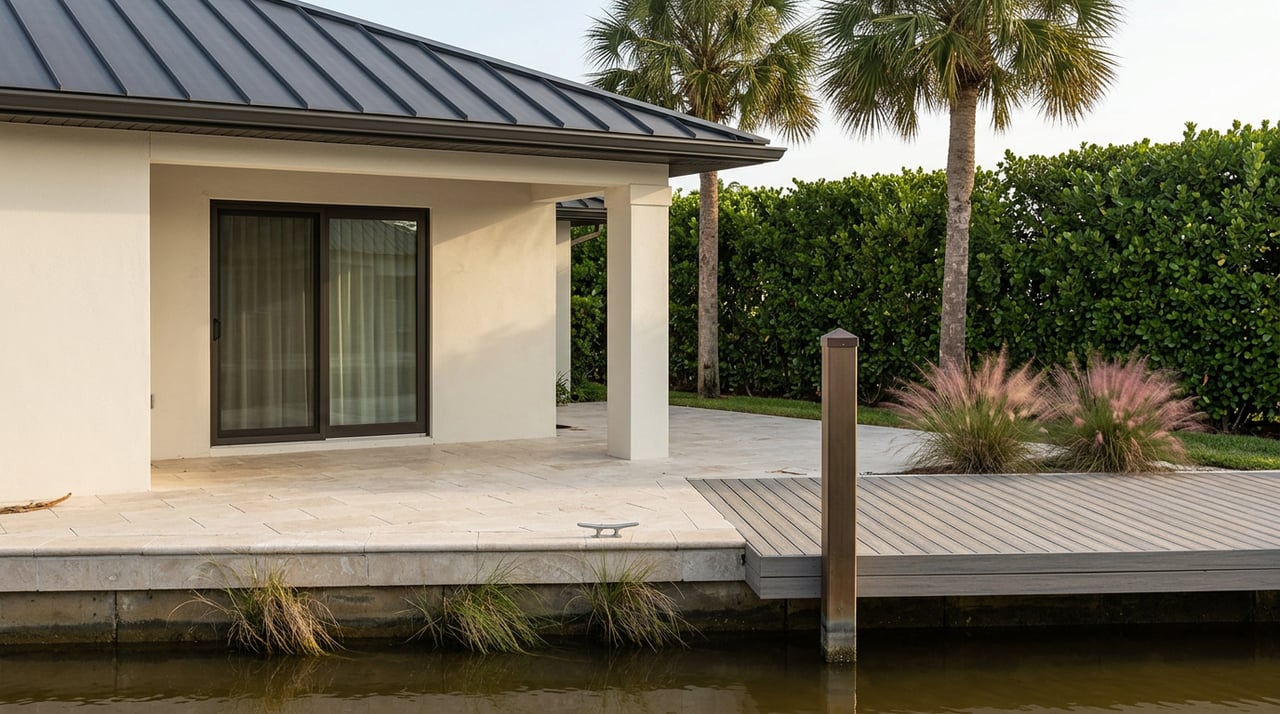
The second is canal and riverfront property, where a private dock changes the math entirely. Harbour Isles, a boating community on the Banana River between Mather's Bridge and the Eau Gallie Causeway, posted a median sale price around $980,000 and roughly $351 per square foot as of late June 2026. That figure comes from a small number of recent closings, so treat it as directional rather than definitive, but the direction is unmistakable: deep-water access adds hundreds of thousands of dollars that a city-wide median simply averages away. Windward Cove, in the same canal-front category, has recently listed properties with close to 100 feet of water frontage and a private boat lift, the kind of listing that skews everything above it.
The third is Lansing Island, a gated community with its own drawbridge, where estate lots run a half-acre on the Grand Canal or a full acre on the Banana River. This is the segment actually responsible for that $7 million top-of-range listing, and it's also almost certainly what's pulling the citywide average $114,000 above the median. One or two Lansing Island closings in a given month can move the average more than a dozen dry-lot sales combined.
There's a fourth pocket worth knowing if short-term rental income matters to your plans: Fortebello, a gated community of Mediterranean-style homes, is one of the few communities in Indian Harbour Beach that permits short-term rentals, which makes it functionally a different product than neighboring gated communities even at a similar price point.
None of this shows up in a single median. It only shows up when you ask which pocket a given listing sits in before you compare its price to anything else.
The citywide average of 56 days on market carries the same problem as the price average. It's blending fast-moving, well-priced dry-lot homes with waterfront listings that can sit for months waiting for the right buyer, and with a documented pattern from 2025 reporting that roughly 89% of recent Indian Harbour Beach sales closed below asking price, with the average sold price landing about 4% under list.
That's not a sign of a soft market. It's a sign of a market where pricing precision matters more than pricing optimism. Homes that launch at an accurate number for their specific pocket, whether that's a Martesia dry lot or a Harbour Isles canal front, tend to attract serious offers in the first two to four weeks. Homes priced off the citywide average, rather than their actual comparable set, tend to sit, get a price cut, and eventually sell for less than they would have if the first number had been right.
The nearly half of homes that go under contract within their first 30 days on market are, almost without exception, the ones priced against their own pocket's real comps rather than against the headline median or average.
Price per square foot used to be the main variable buyers compared across Indian Harbour Beach condo buildings. As of the 2025 and 2026 selling seasons, that's no longer true. Insurance quotes, wind mitigation reports, and reserve fund health now function as a second pricing axis entirely separate from square footage or view.
The Condominiums of Indian Harbour is a useful benchmark for what a healthy building looks like on paper: a reserve fund reported as 100% funded and a condo fee of $475 a month for 2026, the kind of number that lets a buyer's insurance quote and mortgage underwriting move forward without surprises. Locally reported patterns from 2025 show the opposite end of that spectrum too. Older buildings carrying deferred maintenance or facing upcoming special assessments struggled to attract offers, even when the unit itself was in reasonable condition, because buyers increasingly run the insurance numbers before writing an offer rather than after.
Homes with newer roofs, impact windows, and favorable wind mitigation reports carried a tangible pricing advantage last year. That's true at the single-family level and even more pronounced in condo buildings, where the building's financial health is inseparable from the unit's marketability.
Indian Harbour Beach and Satellite Beach sit side by side on the same barrier island, get compared constantly, and behave differently in ways that matter if you're cross-shopping both. Through mid-June 2026, Satellite Beach carried about 6.1 months of inventory while Indian Harbour Beach ran closer to balanced at 5.0 months. Indian Harbour Beach has fewer active listings, but a larger share of its homes sell at or above asking, and it posts a higher quick-sale rate than its neighbor.
Part of that comes down to geography. Indian Harbour Beach is a smaller footprint with less room to build, which means new supply can't loosen the market the way it might somewhere with more available land. Part of it comes down to demand from outside the immediate area: continued hiring tied to aerospace and defense work in the region, including expansion activity and hiring at nearby facilities, has kept a steady stream of out-of-state buyers moving through the market who are less price-sensitive to local median swings and more focused on timing their relocation.
If you're comparing Indian Harbour Beach to another Space Coast city using median price alone, you're comparing an average of three different products as if it were one. The useful question isn't "what's the median here compared to Satellite Beach or Cocoa Beach." It's "which of these three markets, dry lot, canal front, or gated waterfront estate, am I actually shopping in, and what does price per square foot look like inside that specific pocket." Once you ask it that way, the $114,000 gap stops being confusing and starts being useful. It's telling you exactly where the expensive water is.
Is the citywide median a reasonable number to budget around? Only if you're specifically looking at a dry-lot interior home. For canal-front, riverfront, or gated-community properties, the median understates what you'll actually pay, sometimes by several hundred thousand dollars.
Why do some Indian Harbour Beach listings sell in two weeks while others sit for months? Pricing accuracy against the specific pocket's comps, not the citywide average, is the deciding factor. Homes priced against Martesia comps when they should be priced against Harbour Isles comps, or vice versa, tend to sit until a correction brings them in line.
Does condo reserve funding actually affect what I can offer? Yes. A building with a fully funded reserve and a stable monthly fee, like The Condominiums of Indian Harbour, gives insurers and underwriters a clean file to work from. A building facing a special assessment can complicate financing and insurance timelines even when the individual unit shows well.
Working through which of these three markets actually fits your plans, and pricing a home or an offer against the right comparable set rather than a citywide average, is exactly the kind of groundwork Jamie Dandridge does before a listing ever goes live or an offer gets written. If you're weighing a purchase or a sale on this stretch of the barrier island, request a home valuation and get numbers specific to your actual pocket of Indian Harbour Beach, not the citywide blend.
Stay up to date on the latest real estate trends.
Trust him for distinguished real estate service along Melbourne Beach’s coast. With his luxury-market expertise, local insight, and dedicated support, he ensures your buying or selling journey is seamless and successful.